
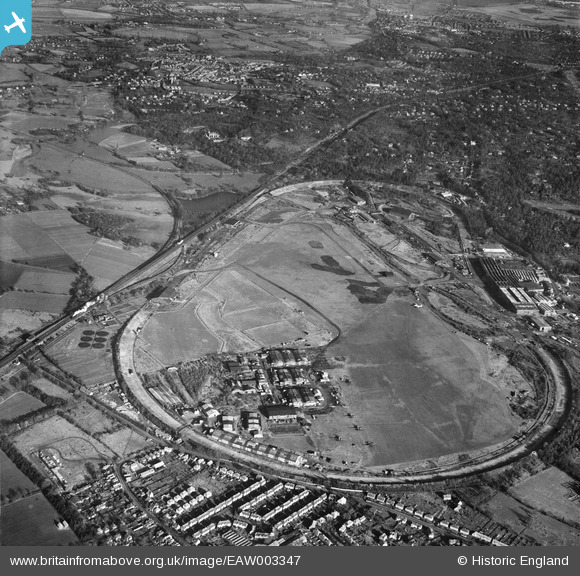
I try to use images taken by me for all my posts so this one will present a bit of a challenge!
As a young boy in the 60’s I used to travel from Aldershot with my mum, to see relatives in London. The train journey took us past a few interesting places. One such, just outside Brookwood, was the Brookwood Cemetery which included the London Necropolis, the largest cemetery in the UK and an interesting story in and of itself.
But further up the line was the real jewel in my travelling crown.
Brooklands
As we approached Weybridge a look out of the window gave a view of an airfield, the home of Vickers Aircraft Company, with concrete banking over the River Wey. I was quite familiar with Brooklands and indeed motor racing from the pre war years thanks largely to the BBC, who would occasionally show old pre war footage and excerpts from the excellent Shell Motorsport series. And to add to that view quite often there would be a VC10 or a Viscount to name just two, sitting on the tarmac. A visual nirvana!
There was also a family connection, because my uncle was an engineer who worked at Brooklands on Wellington Bombers during the war.
Of course the circuit had been closed since 1939 and thus the concrete banking was somewhat dilapidated. A sort of fading monument to past glories.
Thanks to organisers such as the Vintage Sports Car Club, there are still motorsport events held at the venue. The annual New Year Tests are usually held at the end of January and provide a good introduction to the sport for novices.

The Royal Automobile Club Brooklands Grand Prix 1926
I’m reminded of these rail journeys because an e mail landed in my inbox advising me that Brooklands Museum will celebrate a hundred years of Grand Prix racing in Britain. The first Grand Prix, held at Brooklands on the 7th August 1926 was known as The Royal Automobile Club British Grand Prix.
The celebration takes place on the 8th of August and as quoted from the website will include:
Century-spanning Grand Prix car showcase, from historic to modern Formula 1
https://www.brooklandsmuseum.com/
Live demonstrations on the Mercedes-Benz World circuit
Dynamic displays along Members’ Banking and Finishing Straight
Compere led commentary and large screen coverage of the action
Interviews with drivers and motorsport experts
Live music, entertainment and 1926 themed atmosphere
Dedicated hospitality areas and curated food offerings
Interactive motorsport experiences and family friendly activities
You can buy tickets here: https://www.brooklandsmuseum.com/
The Royal Automobile Club:
The RAC was for many years, the organiser of all motorsport in the UK. Tracks, entrants and venues all needed an RAC licence to participate in motorsport events. I think my first RAC race licence cost me the princely sum of 50p.
Recently the RAC has handed this responsibility to an organisation known as Motorsport UK, but it still retains titles to many events and races including the Motor Racing Legends RAC Pall Mall Cup and The Woodcote Trophy, and the GT and Sports Car Cup Family Award.
To celebrate the hundred years of Grand Prix Racing in Britain, The Royal Automobile Concours to be held at Woodcote Park on the 8th July will have on display The RAC British Grand Prix Trophy which, as the name suggests, is presented to the winner of the British Grand Prix.
Additionally, a week before the annual London to Brighton Veteran Car Run, the St James’ Motoring Spectacle will take over Pall Mall as part of the London Motor Week which will also include a display of grand prix cars from the early days to today.
Legends of the Sport
But returning to the 1926 Royal Automobile Club British Grand Prix, the names of legends of the sport filled the admittedly sparse grid of thirteen cars (only nine would start). Those names included Henry Segrave (the first person to travel at over 200 miles per hour in a land vehicle), Robert Benoist (famous racing driver with multiple wins), J.G. Parry Thomas (sadly the first driver to die in a land speed record attempt) and Malcolm Campbell (at one time the holder of both the water and land speed records) among others. The race was run over 110 laps of a shortened circuit, omitting the section of banking that runs behind the test hill.

Attrition
There are plenty of contemporary images of cars racing at Brooklands with their wheels in the air, bouncing on the uneven surface, so it’s not surprising that attrition should have played a large part in the result of the race.
According to Ivan Rendell’s excellent book “The Chequered Flag” published in 1993 there were three Talbots that were fast but fragile; three Delages, one of which lost its exhaust and burnt its drivers’ feet although this one, co driven by Robert Senechal and Louis Wagner would run out as the overall victor; a Bugatti Type 39a driven by Malcolm Campbell, the 39a was essentially a Type 35 with a smaller 1500cc supercharged engine, in second; and, another Delage co driven by Robert Benoist and Andre Dubonnet in third place.

The race was part of the AIACR World Manufacturers’ Championship which comprised five races. The Bugatti Type 39 was the overall winner that year. There was no champion driver since the category didn’t exist in those times. It was the first year of the 1500cc regulations, which goes some way to explaining the lack of entries.
Acknowledgements:
Whilst my memory is pretty good it doesn’t stretch to 1926 so the following websites and publications provided background:
- “The Chequered Flag” by Ivan Rendell, published in 1993
- Wikipedia for background to the various drivers and overall results
- The Royal Automobile Club website: https://www.royalautomobileclub.co.uk/
- The Brooklands Museum: https://www.brooklandsmuseum.com/
Details of The GT and Sports Car Cup can be found here: https://www.gtandsportscarcup.com/
Will you be attending the celebrations?
Feel free to comment and/or like this post.
 Peter Mallett Racing
Leave a comment