

A look back to september this year.
In 1924, according to Google, Lancia produced its Lambda, apparently the first monocoque motor car. Then, in 1937, Google tells us that Vauxhall produced its Ten-Four H-Type, the first monocoque UK production car.
The science behind monocoque construction is quite simple, think of an egg where, rather than a skeleton with a skin pinned to it, the shell provides the structural stiffness as well as the skin, thus it is lighter and in the case of a car, creates a stable platform on which to mount suspension components, power units and all the necessary mechanicals required to make motoring a pleasant experience.
That’s the science.
Apparently, the Morgan Motor Company didn’t get that memo.
Founded in 1909, it produced its first four wheeled vehicle, the 4-4 in 1937 and in the eighty-two years up to 2019, it continued to very successfully produce cars built on a separate chassis with a curvy “square rigged” skin pinned to an ash frame.
Prior to 1937 the company was known for its motorcycle engined three wheelers such as the Super Aero of 1929 which, even though production is no more, still holds a place in the hearts of motoring enthusiasts worldwide. Now however, the currently available Super 3 three-wheeler has a 1.5 litre Ford turbocharged engine.
Russ, our friendly guide, explained all of this when our group from the Bucks and Herts region of the Jaguar Enthusiasts Club had a good wander round the works.
The Morgan Super 3 is somewhat wider and longer than its predecessor, allowing for the larger engine and providing scope for luggage storage. Those “tea-tray” (my words) panels on the sides provide clamps for motorcyle type panniers or softer luggage. There are also storage areas under the seat.

The Super 3 is a monocoque as distinct from the current Plus 4 which has an aluminium “CX” platform and an ash framed body.
The recently announced Supersport has taken this platform, added stiffness and, to quote the Morgan Motor Company website: “Supersport’s new ‘CXV’ Platform weighs just 102kg. A 10% increase in tortional rigidity over the previous ‘CX’ platform is improved by a further 10% when the hard top is fitted.” So, it would appear to be a “semi monocoque” construction. At that weight, the cars are moving into Lotus/Caterham 7 territory.
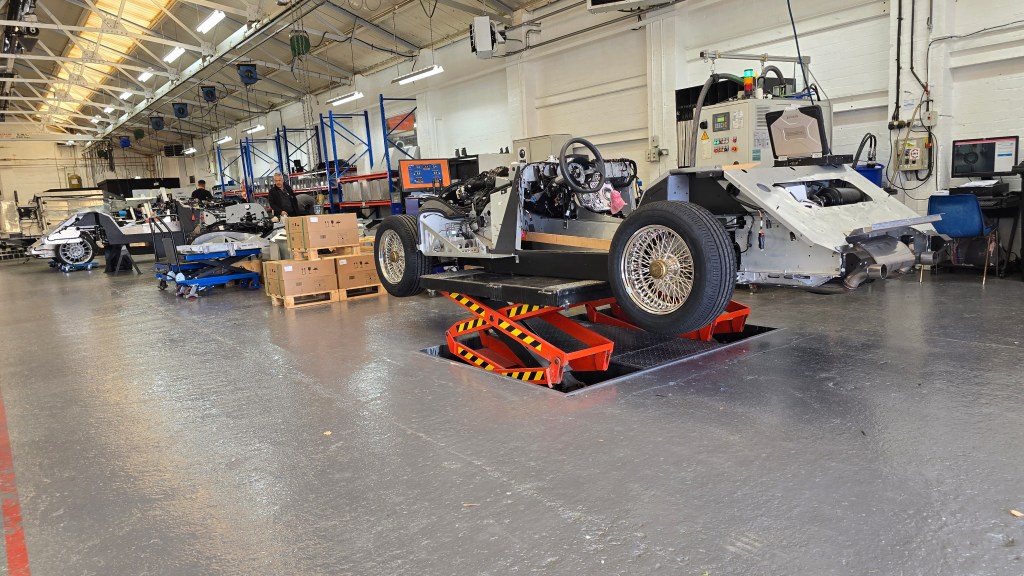
Before going further, a few statistics might help:
It takes 5 years to complete a Morgan apprenticeship; 13 hours to form an ash frame; 7 hours to hand-craft a bonnet; and, 38 hours to create a tailored interior. Overall it takes at least 206 hours to hand craft every unique Morgan.
That word “unique” is quite important because when you order your Morgan, you can specify anything you like in terms of colour, trim, wheels, brakes etc. thus each Morgan is unique to its owner.

It’s impossible to gauge the progress made in production techniques without looking at the history of the cars. Likewise the design basis of the 4 wheeled cars, although modernised still follows the originals from 1937. The importance of that radiator grill shape cannot be underestimated.
They still have the ash frames although now these are bonded to the platform rather than acting as a skeleton for the bodywork. A major reason for retaining the ash frame is sound and vibration deadening. But the ash also supports the shaped aluminium panels which are now thinner and thus lighter than their predecessors.

The current cars have a revised rear end which provides space for (it must be said) a minimal boot. Something previous versions lacked. However it does give the owner the chance to see some of that ash framing because an elegant decision was taken to keep the woodwork exposed here rather than cover it.
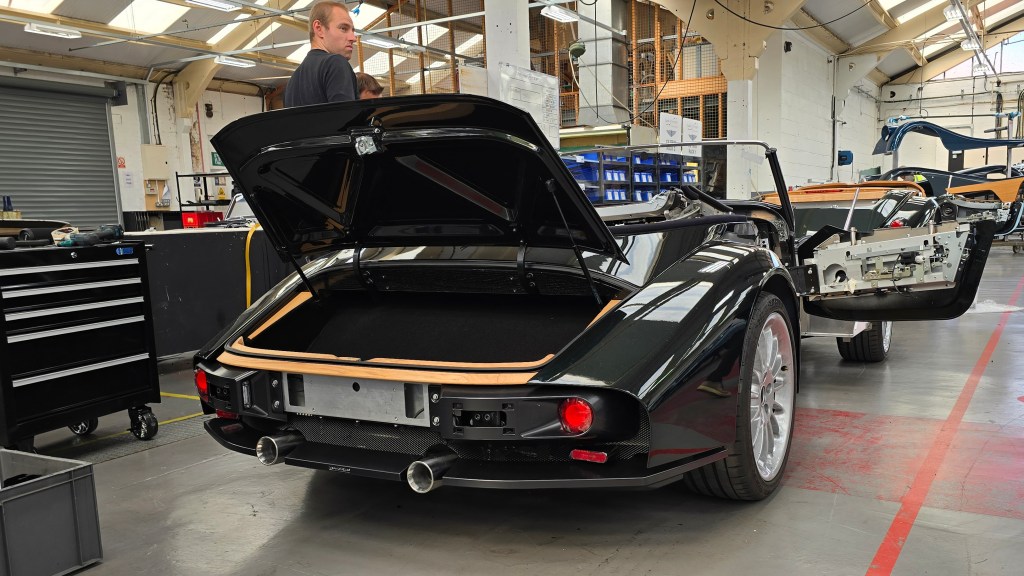
There are various workshops where each car takes shape. Having applied the ash framing the panels are fitted on to the platform to adjust the fitment. The panels are then removed and sprayed in a separate area before being returned to the car for final assembly.

There are no assembly lines, each car is built by a single crafstman and carries a clipboard with the order number and the build record. On the wall there is a record of the hours worked to date on each car and the name of the craftsman who is building the car.
There was a definite buzz about the factory and this is carried on throughout, not only by the workforce but the ethos of the company as a whole. A good example was the presence of a number of Indonesian registered cars in the parking area behind the factory. These were awaiting return to their homeland, having been shipped over by their owners for a tour of the UK, all arranged by the Morgan Motor Company.
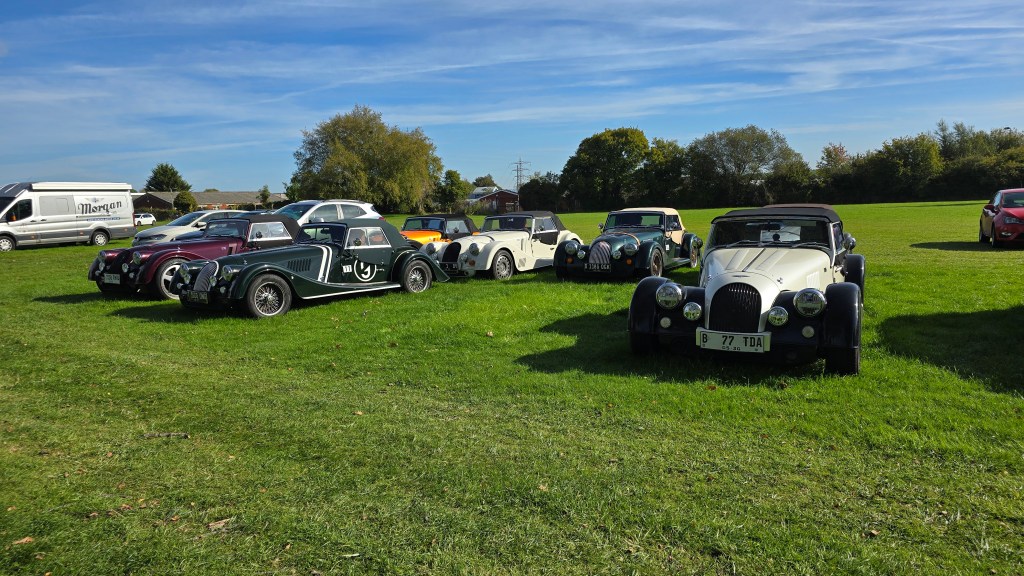
Lots of signs adorn the walls of the factory but one sticks in the mind. It says “Quality is doing it right when nobody is watching.” The evidence is there to see because the current waiting time for your Morgan is around 18 months. And new orders are coming in every week. So they must be doing it right.
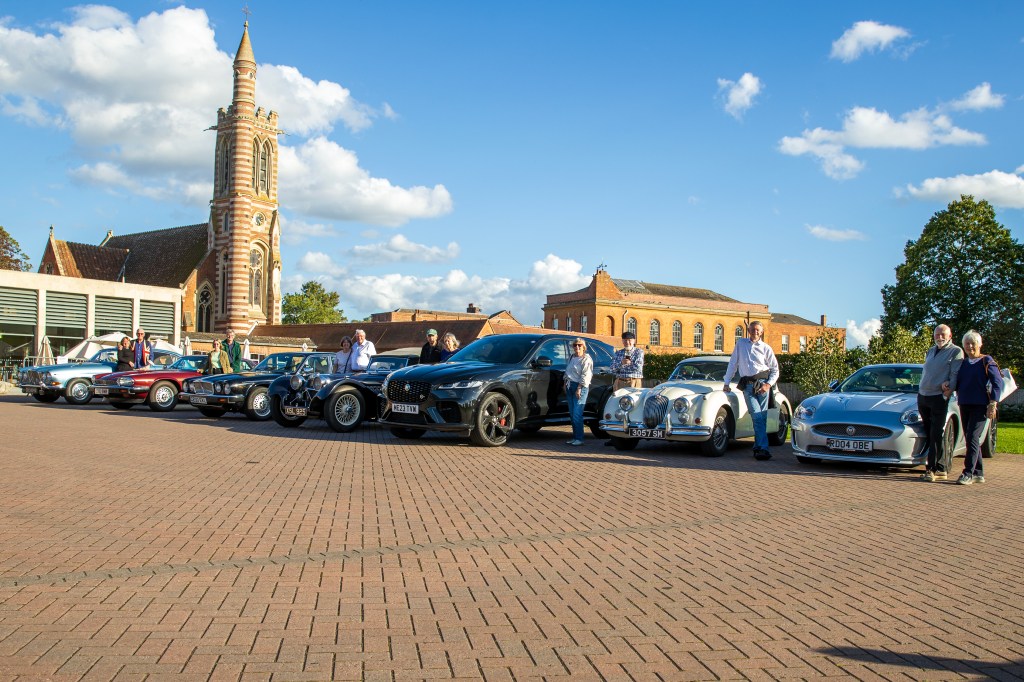
So, thank you to the team at the Morgan Motor Company who made us feel welcome. We finished off with refreshments in the cafe where some of us enjoyed the largest pain au raisin we’d ever seen! It wrapped up a cracking morning!
Anyone interested in further information can visit the Morgan Motor Company website and investigate the various experiences, from driving a car to factory visits, to driving tours.
 Peter Mallett Racing
Leave a comment